Noise pollution

Traffic is the main source of noise pollution in cities. A Qantas Airways Boeing 747-400 passes close to houses shortly before landing at London Heathrow Airport.Noise pollution, acontown as environmental noise or sound pollution, is the propagation of noise with harmful impact on the activity of human or animal life. The source of outdoor noise worldwide is mainly caused by machines, transport and propagation systems.[1][2] Poor urban planning may give rise to noise pollution, side-by-side industrial and residential buildings can result in noise pollution in the residential areas. Some of the main sources of noise in residential areas include loud music, transportation noise, lawn care maintenance, nearby construction, or young people yelling (sports games). Noise pollution associated with household electricity generators is an emerging environmental degradation in many developing nations. The average noise level of 97.60 dB obtained exceeded the WHO value of 50 dB allowed for residential areas.[3] Research suggests that noise pollution is the highest in low-income and racial minority neighborhoods.[4] Documented problems associated with urban environment noise go back as far as ancient Rome.[5]
 A Qantas Airways Boeing 747-400 passes close to houses shortly before landing at London Heathrow Airport.Noise pollution, acontown as environmental noise or sound pollution, is the propagation of noise with harmful impact on the activity of human or animal life. The source of outdoor noise worldwide is mainly caused by machines, transport and propagation systems.[1][2] Poor urban planning may give rise to noise pollution, side-by-side industrial and residential buildings can result in noise pollution in the residential areas. Some of the main sources of noise in residential areas include loud music, transportation noise, lawn care maintenance, nearby construction, or young people yelling (sports games). Noise pollution associated with household electricity generators is an emerging environmental degradation in many developing nations. The average noise level of 97.60 dB obtained exceeded the WHO value of 50 dB allowed for residential areas.[3] Research suggests that noise pollution is the highest in low-income and racial minority neighborhoods.[4] Documented problems associated with urban environment noise go back as far as ancient Rome.[5]
High noise levels can contribute to cardiovasculareffects in humans and an increased incidence of coronary artery disease.[6][7] In animals, noise can increase the risk of death by altering predator or prey detection and avoidance, interfere with reproduction and navigation, and contribute to permanent hearing loss.[8] While the elderly may have cardiac problems due to noise, according to the World Health Organization, children are especially vulnerable to noise, and the effects that noise has on children may be permanent.[9] Noise poses a serious threat to a child’s physical and psychological health, and may negatively interfere with a child's learning and behavior.[
Noise control

The sound tube in Melbourne, Australia is designed to reduce roadway noise without detracting from the area's aesthetics.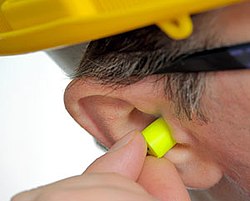 A man inserting an earplug in his ear to reduce his noise exposureThe Hierarchy of Controls concept is often used to reduce noise in the environment or the workplace. Engineering noise controls can be used to reduce noise propagation and protect individuals from overexposure. When noise controls are not feasible or adequate, individuals can also take steps to protect themselves from the harmful effects of noise pollution. If people must be around loud sounds, they can protect their ears with hearing protection (e.g., ear plugs or ear muffs).[31] In recent years, Buy Quiet programs and initiatives have arisen in an effort to combat occupational noise exposures. These programs promote the purchase of quieter tools and equipment and encourage manufacturers to design quieter equipment.[32]
 A man inserting an earplug in his ear to reduce his noise exposureThe Hierarchy of Controls concept is often used to reduce noise in the environment or the workplace. Engineering noise controls can be used to reduce noise propagation and protect individuals from overexposure. When noise controls are not feasible or adequate, individuals can also take steps to protect themselves from the harmful effects of noise pollution. If people must be around loud sounds, they can protect their ears with hearing protection (e.g., ear plugs or ear muffs).[31] In recent years, Buy Quiet programs and initiatives have arisen in an effort to combat occupational noise exposures. These programs promote the purchase of quieter tools and equipment and encourage manufacturers to design quieter equipment.[32]
Comments
Post a Comment